

The real estate landscape of Rajasthan is undergoing a significant transition, driven by the emergence of high-yielding micro-markets centered around spiritual tourism. While traditional commercial centers and metropolitan areas navigate high entry costs and modest growth rates, devotional corridors are experiencing unprecedented demand.
As of 1st July 2026, the Khatu Shyam Ji corridor in the Sikar district of Rajasthan stands out as one of the most active real estate investment hotspots in North India. Driven by record pilgrim traffic, transformative infrastructure developments, and a transition toward regulated, developer-led gated townships, this micro-market has captured the attention of institutional developers and retail investors alike.
The Macroeconomic Foundation: The Spiritual Tourism Multiplier
The rapid development of Khatu Shyam Ji’s real estate market is fundamentally supported by robust demand dynamics. According to the Rajasthan Tourism Department, Khatu Shyam Ji is the state’s most visited religious destination. In 2025, the shrine recorded an annual footfall of approximately 2.54 crore devotees, leading the state’s religious tourism rankings.
During peak events, such as the 15-day Phalguna Mela, the town manages concentrated influxes of 30 to 40 lakh pilgrims. This steady flow of visitors has shifted from a seasonal phenomenon to a year-round economic engine.
This steady volume of visitors supports a highly active, service-oriented economy. In Rajasthan, tourism accounts for approximately 6% of the Gross State Domestic Product (GSDP), with religious tourism specifically contributing 0.9% to GSDP and supporting 0.7% of state employment. The high volume of visitors directly increases the demand for hospitality assets, including hotels, guest houses, and retail spaces.
Furthermore, this demand is receiving a boost from external state initiatives. In late 2025, programs like the Mukh Mantri Teerath Yatra Yojna in Punjab expanded their subsidized travel routes to include Khatu Shyam Ji, bringing an additional 1.5 lakh pilgrims to the region and expanding the consumer base for local commercial establishments.
[State & Central Government Infrastructure Funding] │ ▼ [Year-Round Pilgrim Footfall: 2.54 Crore] │ ▼ [Multi-Sector Economic Expansion: Transport, Retail, Hospitality] │ ▼ [Elevated Property Valuations: 20% to 25% Spiritual Premium]This structural demand supports a reliable appreciation premium. Historically, land values in areas adjacent to prominent spiritual hubs in India appreciate at rates 20% to 25% higher than in comparable non-pilgrimage regions. In Khatu Shyam Ji, limited land availability near the central temple has turned the surrounding transport corridors into highly competitive investment zones, driving up land values and creating long-term opportunities for early-stage investors.
Infrastructure Transformation: Connecting the Corridor
The transition of Khatu Shyam Ji from a traditional pilgrimage destination to an institutional real estate hotspot is accelerated by a series of major public infrastructure projects. These projects are designed to resolve long-standing traffic bottlenecks while integrating the Sikar-Reengus belt into regional expressways.
The Kotputli–Kishangarh Greenfield Expressway
The most significant road project in the region is the 181-kilometer, six-lane, controlled-access Greenfield Expressway connecting Kotputli and Kishangarh, which commenced active construction in December 2025. Built at an estimated cost of ₹6,906 crore and requiring the acquisition of 1,679 hectares of land, this corridor serves as a strategic alternative to the heavily congested National Highway 48 (NH-48).
By bypassing congested urban nodes, the expressway is projected to reduce travel times between Delhi/NCR and Khatu Shyam Ji from approximately five hours to just two hours. This drastic reduction in transit time shifts the market’s utility. Rather than being viewed solely as a long-distance pilgrimage site, Khatu Shyam Ji is becoming a highly accessible weekend retreat for wealthy urbanites in NCR and Jaipur, accelerating demand for luxury second homes and retirement villas.
Sundarpura (Khatu Shyam Ji) Railway Station
Rail connectivity is also undergoing a major upgrade. Currently, rail-bound pilgrims must deboard at Ringas Junction – located approximately 17 kilometers away – and arrange secondary road transport. To address this bottleneck, the Ministry of Railways sanctioned the 17.49-kilometer Ringus–Khatushyamji rail line, which is scheduled for completion by March 2028.
In a major development in June 2026, the Ministry of Railways finalized the layout and initiated construction on a dedicated station at Sundarpura (formally designated as Khatu Shyam Ji station). Located just 11 kilometers from the temple, this new station is being built under a strict 12-month completion timeline. The establishment of direct rail connectivity will democratize access for mid-to-low-income pilgrims nationwide, ensuring a steady, year-round baseline of commercial and hospitality demand.
Bypass Projects and Ring Road Approvals
To manage local traffic, the central government approved a comprehensive Ring Road project and directed the NHAI to widen the Jaipur–Ringus (NH-52) highway from four lanes to six lanes. This is supported by the regional construction of the 6.5-kilometer Fatehpur–Nawalgarh bypass. Measuring 60 meters in width and acquiring 143,825 square meters of land across 43 khasras in Jagmalpura and Bhadwasi, this bypass redirects heavy commercial truck traffic away from Sikar’s municipal core, protecting residential neighborhoods from traffic congestion.
Budget Allocations for Model Roads
In the Rajasthan State Budget for the financial year 2026-27, presented in February 2026, the state government allocated ₹30 crore to develop the main entry points of prominent tourism sites—including Khatu Shyam Ji, Pushkar, Deshnok, and Pokhran—as high-quality, landscaped “model roads”. This initiative directly upgrades the aesthetic appeal and pedestrian infrastructure at the primary entryways to the town, supporting nearby commercial property valuations.
Real Estate Price Dynamics: Market Trends in 2026
As of July 2026, land prices in the Sikar-Khatu corridor reflect a highly active micro-market. Driven by speculative interest and infrastructural milestones, property rates have exhibited double-digit annualized growth.
Defining the Geographic Price Spread
The micro-market is characterized by a distinct separation in pricing between the immediate township area and the broader highway connectivity zones.
- Khatushyamji Local Limits: Properties within the immediate municipal boundaries of the temple town have achieved average land rates of ₹1,200 per square foot during the April–June 2026 quarter. This represents a sharp 60% year-on-year appreciation from the ₹750 per square foot benchmark recorded in the same quarter of 2025.
- Khatu Highway & Sikar Fringe Belt: The broader, highly connected residential zones along the primary state highways command a premium due to wider approach roads and superior civic infrastructure. These plots reached an average of ₹2,350 per square foot in mid-2026, showing a steady, institutionalized appreciation of 11.9% over the past year.
| Quarter | Average Land Price (₹/sqft) | Quarter-on-Quarter Appreciation (%) | Year-on-Year Growth (%) | Market Drivers & Catalysts |
| Jan–Mar 2025 | ₹650 | 0% | — | Baseline market stabilization. |
| Apr–June 2025 | ₹750 | 13% | — | Modified State Budget allocations. |
| July–Sept 2025 | ₹1,000 | 25% | — | Central Swadesh Darshan 2.0 approval. |
| Oct–Dec 2025 | ₹1,200 | 17% | 84.6% (vs. Q4 2024) | Greenfield Expressway commencement. |
| Jan–Mar 2026 | ₹950 | -26% | 46.1% | Post-festival seasonal volume correction. |
| Apr–June 2026 | ₹1,200 | 21% | 60.0% | Sundarpura rail head construction begins. |
Standard 100-square-yard plots (~900 square feet) in developing residential projects typically trade between ₹8 Lakh and ₹15 Lakh, providing an accessible entry point compared to saturated tier-2 cities like Jaipur.
The Transition to Planned Gated Townships
The real estate market in Khatu Shyam Ji is moving away from unapproved agricultural land subdivisions. Driven by the strict enforcement of Real Estate Regulatory Authority (RERA) regulations and more sophisticated buyer preferences, the region is seeing a surge in large-scale, planned townships. These infrastructure-backed projects integrate modern urban planning with security features and lifestyle amenities to support long-term capital appreciation and spiritual tourism infrastructure.
Institutional Blueprint: Khatu Green Heaven
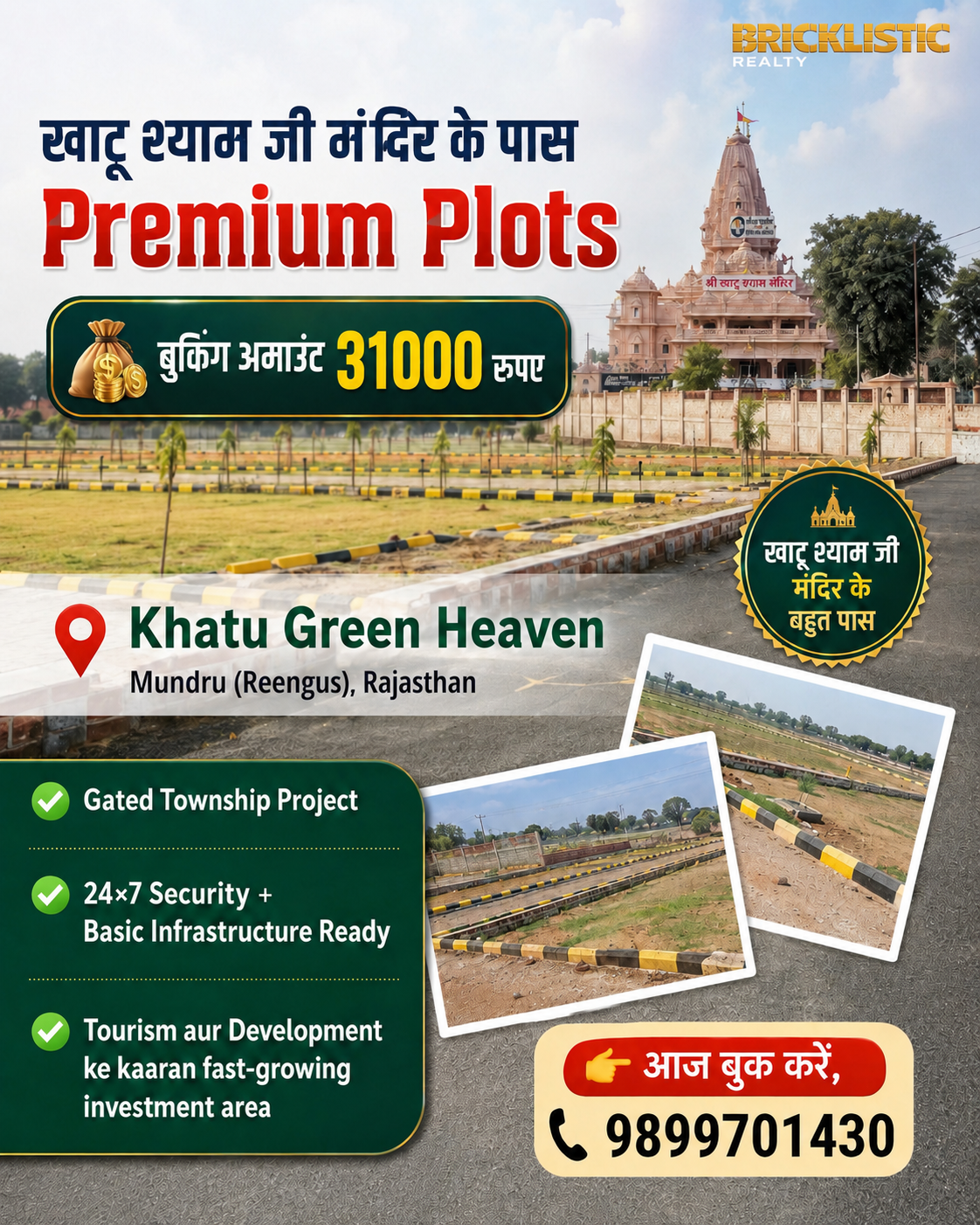
Demonstrating the transition toward high-density mixed planning, the Khatu Green Heaven layout situated at Mundru (Reengus) outlines the shifting standard for peripheral township developments along the Delhi-Shahpura-Ajitgarh-Mundru-Reengus corridor.
| Project Element | Specifications & Spatial Allocation |
| Total Area | 47 Acres (~74 Pakka Beeghas) |
| Residential Zoning | 34 Acres (~54 Pakka Beeghas) encompassing 536 residential plots and 55 commercial shops |
| Hospitality Anchor | 13 Acres (~20 Pakka Beeghas) reserved for a premium proposed resort |
| Land Use Breakdown | Residential Plotting: 52.82% | Parks & Open Green Space: 2.29% | Public Utilities & Infrastructure: 3.60% | Internal Roads: 29.46% |
| Proximity Metrics | Reengus Railway Station: 10 mins | Nishan Bhawan: 10 mins | Khatu Shyam Temple: 25 mins | Jaipur: 50 mins | Delhi: 4 hours |
Townships of this scale are engineered to manage dual-demand frameworks, capturing residential plot buyers while incorporating integrated amenities—such as standard 3-tier security, rainwater harvesting networks, dedicated welcome pavilions, and high-quality internal road configurations (ranging from 30-foot to 60-foot wide layouts). Furthermore, the addition of extensive lifestyle integrations, such as open gym areas, cricket turfs, spa facilities, and treehouses, marks a definitive structural pivot from unorganized rural plots to self-contained real estate ecosystems.
Segment Analysis: Identifying the Optimal Investment Plays
Succeeding in a pilgrimage-centric real estate market requires a highly targeted strategy. Investors must choose their location based on their capital risk tolerance, holding capacity, and desired income model.
1. Temple-Core Commercial and Hospitality Assets
- Target Areas: Within a 2-kilometer radius of the main temple shrine.
- Investment Profile: High Risk, High Capital Expenditure, High Yield.
- Core Strategy: This segment is highly lucrative for hospitality developers targeting the steady stream of pilgrims. Capitalizing on the constant demand for short-term accommodation, properties here can generate attractive rental yields during peak periods like Ekadashi and regional festivals.
- Critical Risks: Land prices in this segment are highly inflated. Furthermore, properties are highly vulnerable to local municipal zoning restrictions, security cordons during festivals, and severe physical congestion.
2. The Reengus/Ringas Transit Corridor
- Target Areas: Lands adjacent to the NH-52 belt, the incoming Sundarpura station, or the Reengus-Khatu link road (e.g., transit areas like Mundru).
- Investment Profile: Medium Risk, Moderate Capital, High Growth.
- Core Strategy: This is widely considered the most balanced investment play in the region. Driven by the construction of the Sundarpura rail head and the expansion of the RIICO industrial areas, this belt benefits from a dual-purpose demand model. Developers can build gated plotted communities targeting retirees, second-home buyers, or commercial warehouses and logistics parks servicing regional trade.
3. Sikar City and Municipal Fringe Pockets
- Target Areas: Sikar-Losal route, Nawalgarh Road, and bypass entry points.
- Investment Profile: Low Risk, Moderate Growth, Capital Preservation.
- Core Strategy: Sikar serves as the administrative, educational, and medical anchor for the district. Investing in city-fringe plots provides exposure to the region’s overall economic expansion without the speculative volatility associated with the temple core. The target audience here is highly stable, consisting of local residents, educational professionals, and business owners looking for long-term capital preservation.
Strategic Planning and Regulatory Hurdles: Draft Master Plan 2041
Despite its strong growth trajectory, Khatu Shyam Ji’s real estate market presents unique regulatory, physical, and legal challenges. Speculative booms driven by devotional enthusiasm often obscure structural market risks.
The Draft Master Plan 2041 Framework
To address the issues of uncontrolled development, parking scarcity, and poor infrastructure, the Khatu Shyam Ji Municipality published the Draft Master Plan 2041. The plan formally integrates seven critical revenue villages into the urban planning zone:
- Khatushyamji
- Hanumanpura
- Sitarampura
- Syami Ki Dhani
- Jhamawas
- Chomu Purohitan
- Kerpura
This formal planning framework is designed to manage a projected population expansion from 11,374 residents (as of the 2011 census) to an estimated 35,544 residents by the horizon year 2041. By establishing clear municipal zoning boundaries, the Master Plan 2041 protects agricultural lands from unauthorized plotting and designates specific zones for commercial, hospitality, and public utility development.
Environmental Compliance and Sewage Infrastructure
To manage the heavy strain on local resources during major festivals, the State Government of Rajasthan has prioritized waste and sewage management. In compliance with the National Green Tribunal (NGT) directives, the state has committed to a phased construction timeline for Sewage Treatment Plants (STPs) across regional municipal bodies, with major projects scheduled for operational delivery through December 2026 and June 2027.
The “Crowd-Day” Accessibility Paradox
The primary operational risk for properties near the temple core is physical accessibility during high-traffic events. While a commercial plot or villa might appear highly accessible on a quiet weekday, the local administration enforces strict crowd-control measures during the monthly Ekadashi and the annual Phalguna Mela. Entire streets are routinely barricaded, vehicular traffic is restricted, and pedestrian routes are diverted. Consequently, core commercial buildings, hotels, and second homes can become physically inaccessible for days at a time, limiting their utility and operational income.
Legal Titles and Agricultural Conversion Hurdles
A significant portion of land offered by local brokers near Khatu Shyam Ji consists of agricultural plots that lack formal municipal approvals. Purchasing such land carries substantial risk:
- Section 90A and Section 80 Compliance: Under the Rajasthan Land Revenue Act, agricultural land cannot be used for residential or commercial construction until it undergoes official conversion (via Section 90A or Section 80) and receives an approved layout map from the local town planning authority or Nagar Palika.
- RERA Mandate: Any plotted development exceeding 500 square meters or comprising more than eight plots must be registered under the Rajasthan Real Estate Regulatory Authority (RERA). Purchasing plots in unapproved, non-RERA developments leaves the buyer with no consumer protection and high vulnerability to title disputes.
Investors must verify that prospective land parcels do not fall inside proposed green zones, government buffer corridors, or designated road-widening paths. In Sikar, public friction and protests have previously emerged regarding alignment changes in the Master Plan 2041 draft, highlighting the importance of verifying land-use classifications on the state planning portal prior to transaction execution.
Conclusion and Strategic Outlook
As of July 2026, the transformation of Khatu Shyam Ji from a localized pilgrimage site into a modern, high-growth real estate corridor is backed by solid economic fundamentals. The combination of sustained pilgrim traffic, major highway and rail connectivity, and institutionalized gated developments has created a highly productive real estate ecosystem.
For long-term investors, the most attractive opportunities lie in the planned connectivity corridors between Reengus and Khatu, where entry costs remain reasonable and infrastructure growth is actively occurring. However, navigating this fast-evolving market requires strict due diligence. To capitalize on Khatu Shyam Ji’s real estate potential while protecting capital from speculative bubbles, buyers must prioritize legal title verification, RERA compliance, and a clear understanding of regional master plans.