

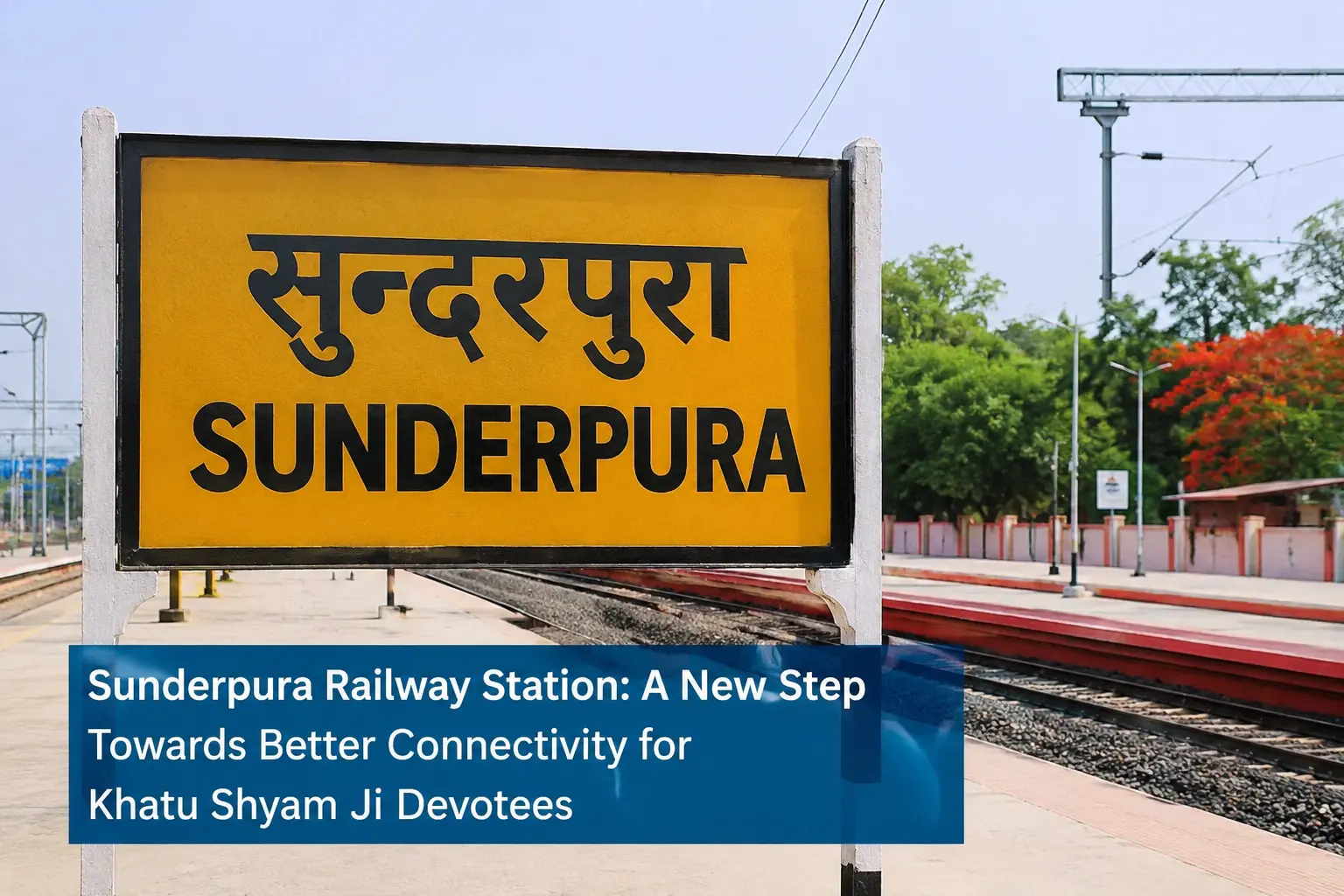
The planning and execution of transport networks near major cultural and spiritual centers represent a critical component of state-led infrastructure development in India. The official announcement of the new Sunderpura Railway Station near the Shri Khatu Shyam Ji Temple by Union Railway Minister Ashwini Vaishnaw highlights a targeted approach to managing high-volume pilgrim transit while modernizing regional rail networks.
This project addresses long-standing demands for direct, efficient rail access to one of northern India’s most heavily visited religious shrines. Built as a passenger-focused facility, the station is designed to ease transit bottlenecks, reduce travel times, and stimulate local commercial activity within the Sikar district of Rajasthan.
Technical and Operational Profile of the Sunderpura Station
The proposed railway station, officially named “Khatu Shyam Sundarpura,” will be constructed on the Sikar–Ringas rail section of the North Western Railway (NWR) zone, positioning it administratively within the Jaipur Division. Located between the existing Palsana and Bawadi Thikaria (also spelled Baori Thikria) stations, the facility will initially operate as a halt station with infrastructure designed for future upgrades.
The primary goal of this project is to shorten the road transit phase for travelers arriving by rail. Currently, the nearest railhead is Ringas Junction, which requires a road journey of 17 to 19 kilometers to reach the temple. The new Sunderpura station, located roughly 11 to 12.3 kilometers from the temple, will cut this distance and reduce travel times.
| Operational Parameter | Details and Specifications |
| Project Name | Khatu Shyam Sundarpura Railway Station |
| Administrative Control | Jaipur Division, North Western Railway (NWR) Zone |
| Section Alignment | Sikar–Ringas Rail Section (between Palsana and Bawadi Thikaria) |
| Estimated Project Cost | ₹20 Crore |
| Distance to Temple | Approximately 11 to 12.3 Kilometers |
| Primary Structural Function | Modern Halt Station with planned terminal upgrades |
| Land Allocation | Earmarked site provided by the Rajasthan State Government |
To ensure the station can handle projected traffic volumes, the Ministry of Railways is integrating the Sunderpura project with the approved ₹470.34 crore Sikar–Ringas track doubling project. This 50.06-kilometer doubling initiative will expand rail capacity, allowing the Sunderpura halt to handle a high volume of special pilgrim trains without disrupting existing regional timetables.
Initially, the station is projected to handle daily passenger volumes of 30,000 to 35,000, with capacity scaled to absorb higher loads during major annual festivals.
Historical Context and Socio-Religious Transit Demands
The Khatu Shyam Ji Temple is constructed of white Makrana marble and dedicated to Barbarika, the grandson of the Pandava warrior Bhima. According to Hindu mythology, Barbarika sacrificed his head to Lord Krishna before the Kurukshetra war and was blessed to be worshipped as a manifestation of Krishna in the Kali Yuga.
Revered as “Haare Ka Sahara” (the support of the defeated), the temple attracts major crowds, drawing an estimated 50 to 60 lakh (5 to 6 million) devotees annually.
The need for better infrastructure becomes especially clear during the annual 15-day Phalguna Mela, which takes place in the Hindu month of Phalguna (February–March). During this peak period, the temple and its surrounding town, which has a base population of only 5,000, see a massive influx of 30 to 40 lakh pilgrims.
A central ritual of this festival is the Nishan Yatra, where barefoot devotees carry sacred saffron flags (nishaans) from Ringas Junction to the temple, walking along the highway and creating significant road congestion. This walk is complemented by historical traditions, such as the hoisting of the 300-year-old Surajgarh white flag, which is carried on a 152-kilometer padyatra to the temple during the festival.
[Ringas Junction (Existing Railhead)]
       │
       ├─ (Current Road Route: 17–19 km road travel with heavy traffic)
       ▼
[Khatu Shyam Ji Temple]
       ▲
       ├─ (Proposed Road Route: 11–12.3 km via new link roads)
       │
[Sunderpura Railway Station (New Strategic Halt)]
The push for direct rail connectivity gained significant momentum in April 2023, when Sumedhanand Saraswati, then Sikar’s Member of Parliament, formally requested a dedicated rail link to reduce traffic on local roads.
The construction of Sunderpura station addresses these demands by offering an alternative transit option closer to the temple, helping to separate pedestrian pilgrim flows from commercial vehicle traffic.
Part of a Unified Regional Transport Network
The Sunderpura station announcement was part of a larger roll-out of rail infrastructure projects across Rajasthan. On June 21, 2026, Union Railway Minister Ashwini Vaishnaw and Rajasthan Chief Minister Bhajanlal Sharma inaugurated several projects designed to expand regional capacity and modernise rolling stock maintenance.
| Complementary Rail Initiative | Strategic Project Scope | Investment and Capacity |
| Ringas–Khatu Shyamji Rail Line | Directly links Ringas to Khatu Shyamji over a new 17.49 km alignment. | Budgeted at ₹254.06 Crore. |
| Khatipura Mega Coaching Terminal | Modern passenger terminal in Jaipur featuring AI-based automated maintenance systems. | Budgeted at ₹205 Crore; supports maintenance of ~450 trains monthly. |
| Darbhanga Amrit Bharat Express | Direct, high-frequency rail link connecting Jaipur with Darbhanga in Bihar. | Operates 6 days a week with 8 sleeper and 11 general coaches. |
| Sikar Station Pit Line | New rolling stock cleaning, inspection, and maintenance facility. | Designed to support future rail service expansions in the Shekhawati region. |
These projects are connected to the planned Khatu Shyam Ji–Salasar–Sujangarh rail line project, which aims to link several major religious sites in Rajasthan.
Following the approval of the Final Location Survey (FLS) in 2024, drone-based mapping and site feasibility assessments have mapped out a 45-kilometer alignment. This corridor will feature nine newly planned stations:
- Khatu Shyam Ji: Serving as the primary southern terminal for temple access.
- Madni: Connecting rural agricultural communities to the rail network.
- Palsana: Linking the new corridor to the existing Sikar–Ringas mainline.
- Rashidpur Khori: Providing intermediate commercial and community access.
- Hapas: Serving local village clusters.
- Sola: Providing operational support and traffic management along the route.
- Salasar Balaji: Providing direct rail access to the Salasar Balaji temple.
- Lodhasar: Supporting transit for regional communities.
- Sujangarh: Serving as the northern terminal linking to the broader NWR network.
Architectural Heritage and Passenger Facility Design
The architectural design of the Sunderpura station will showcase Rajasthan’s cultural and historical heritage. Designed to blend traditional aesthetics with modern amenities, the station’s main entrance will feature a statue of Baba Khatu Shyam, immediately identifying the terminal as part of the pilgrimage experience.
               [Traditional Rajasthani Facade]
                              │
            ┌─────────────────┴─────────────────┐
            ▼                                   ▼
[Baba Shyam Entrance Statue]            [Passenger Amenities]
  - Visual identity                       - High-capacity booking office
  - Integration with pilgrim experience   - Spacious waiting halls
                                          - Accessible sanitation
                                          - Digital signage & ticketing
The interior layout is planned to handle large crowd flows safely and efficiently. Key facilities include a high-capacity booking office with digital ticketing, large waiting halls with improved ventilation, accessible restrooms, and clear signage to help guide passengers during peak travel periods.
Additionally, a new unpaved link road connects the station site directly to the main Khatu Shyam highway, simplifying onward travel for arriving pilgrims.
Local Economic Growth and Development
The construction of Sunderpura station is expected to drive economic growth and development in Sikar’s rural areas. The project site is currently an undeveloped sandy tract. The introduction of the railway station will encourage commercial development, transforming the area into an active transit hub.
Regional planners estimate the project will create more than 50,000 direct and indirect jobs, particularly in transport, hospitality, and retail. Local transport operators, such as auto-rickshaws and taxis, will see increased demand for passenger transfers between the station and the temple.
The hospitality sector is also expected to expand, with growing demand for budget hotels, guesthouses, and dharamshalas near the station.
Furthermore, small-scale vendors and artisans will benefit from a larger market for traditional handicrafts, local food, and religious items. This economic shift will offer more stable, service-oriented employment opportunities for a population that currently relies primarily on seasonal agriculture and daily-wage labor.
Engineering Timelines and Project Execution
The development of the Khatu Shyamji-Sunderpura station will follow a phased engineering schedule managed by the North Western Railway. During a site inspection in June 2026, Minister Ashwini Vaishnaw finalized the project parameters with NWR engineers.
The project will progress through the following key phases:
- Phase 1: Preparatory Engineering and Signaling Integration (Months 1–9)Initial work will focus on detailed engineering surveys, signaling configuration, and civil works on the Sikar–Ringas line. This phase includes installing passing loops and integrating electrical systems with the broader rail network.
- Phase 2: Station Construction (Months 10–22)Building on the completed track work, construction of the station building, platforms, and passenger facilities will begin. This phase is scheduled for completion within a 12-month window once site preparation is complete.
- Phase 3: Network Integration and Terminal Upgrades (Target 2029)Following the opening of the halt station, the facility will undergo systematic upgrades to transition into a passenger terminal. Full operational integration with the Sikar-Ringas track doubling project is targeted for 2029.
By coordinating track-doubling, station construction, and corridor planning, Indian Railways is building a modern, durable transport link. This integrated approach will improve regional passenger transit, protect local ecosystems, and support economic development across Rajasthan’s prominent pilgrimage circuits
Disclaimer: This article is intended for informational purposes only. While every effort has been made to ensure the accuracy of the information, railway plans, project timelines, and government announcements may change over time. Readers are encouraged to verify the latest updates through official Indian Railways and government sources before making any travel or investment decisions.